Table of Contents
Yes—you can watch IPTV for free if the service owns its infrastructure instead of renting scraped links. A standalone, cloud-based application that talks directly to offshore backend servers delivers 20,000+ live channels and daily-refreshed 4K VOD to Firestick and Android TV, with $0 monthly fees, 99.9% uptime, and zero M3U maintenance.
At 8:47 p.m. on a Friday, something quietly remarkable happens on the internet. In more than fifty thousand living rooms, hands reach for remotes within the same few minutes. Thumbs scroll past sports feeds, a film that left theaters recently, a newsroom broadcasting from another hemisphere. And then, in under a second, every one of those televisions begins pulling a flawless picture from a fleet of servers most viewers will never think about again. No invoice arrives for any of it. That single sentence is the honest answer to the question you typed into the search bar: can i watch iptv for free. Not a trial that memorizes your card. Not a cracked box gathering dust. Not a playlist you babysit every weekend. The modern “yes” is built on a standalone auto-updating IPTV client that owns its entire delivery chain, from the offshore rack to the HDMI port in your wall.
Before you install anything, though, you deserve to see the machinery. Too many “free television” promises are traps wearing a friendly mask, and the only way to separate the engineering from the extortion is to trace the signal itself—where it is born, how it travels, what tries to kill it, and what finally lands on your screen. This guide walks that exact path, then hands you the three-move deployment ritual for Firestick and Android TV.
8:47 PM, Friday Night: Why the Question Deserves a Better Answer
Nobody wakes up deciding to hate their television. The frustration accumulates in small, expensive increments. A “broadcast fee” appears on the statement. The promotional cliff hits month thirteen. The one channel the household actually loves migrates into a “premium tier” overnight. Meanwhile, the DIY crowd that fled to internet television discovered its own misery: links that die mid-match, players that crash on launch, guides that demand an engineering degree. So the search query gets more specific every year, and this one is the sharpest version yet—can i watch iptv for free, without surrendering something else in exchange?
Because that is the real question hiding inside the keyword. Every bad answer charges you in a hidden currency:
- The inflation currency — cable’s annual hikes, box rentals, and surcharges for channels nobody in the house has ever opened.
- The card-on-file currency — “free trials” whose only purpose is to convert into invoices the moment you forget to cancel.
- The attention currency — ad-injected “free” players that interrupt a penalty shootout to sell you detergent.
- The labor currency — scraped playlists that cost you a Saturday of hunting, pasting, testing, and re-pasting.
A genuinely free platform must refuse all four currencies. That refusal is not a marketing posture; it is an architectural decision, and it is the thread this article follows.
Two Roads Diverge in Your HDMI Port
Internet television travels one of two paths to reach your sofa. Understanding the difference between them is the entire game.
Road One: The Scraped-Playlist Path and Its 24-Hour Body Count
An M3U playlist is a plain-text list of stream addresses, usually scraped from forums and pasted into a generic player. For one evening it can feel like genius. Then the physics of scraped infrastructure assert themselves. Host servers rotate addresses and tokens daily to dodge detection and shed load, which is why the classic symptom is the 24-hour crash: Friday’s working list becomes Saturday’s wall of gray tiles. Even while a link is technically alive, it is usually overloaded—hundreds of strangers hammering one unmanaged host—so the feed buffers at the exact second the match reaches its climax.
Then the electronic program guide decodes incorrectly, or not at all. Then three channels in your favorites list go dark. Then you are back on the forums at midnight, hunting a replacement link like a mechanic scavenging parts for a car whose manufacturer vanished years ago. People describe this hobby as “free IPTV.” It is a subscription paid in weekends.
Road Two: The Engineered Path
The engineered path inverts the responsibility. Instead of handing you a text file and wishing you luck, a serious platform hands you a compiled application that speaks directly to managed backend servers. Channel rotation, token refresh, dead-stream surgery, guide synchronization—all of it executes server-side, continuously, invisibly. You never paste a link. You never rebuild a grid. You open the app, and the app is already current. That inversion—maintenance performed by infrastructure instead of by you—is the single reliable test for whether a “free IPTV” offer is a product or a prank.
Riding the Packet: A Guided Tour of the Engineered Path
Follow one frame of video from birth to glass and the statistics stop sounding like advertising. They start sounding like plumbing.
Birth Offshore: Where Throttling Cannot Follow
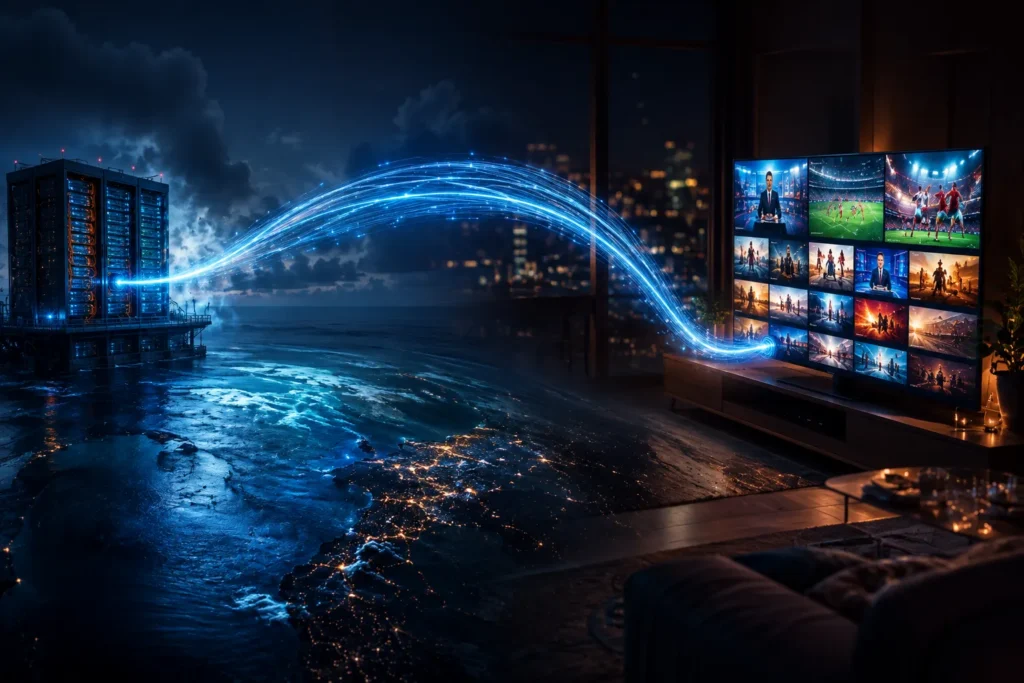
Domestic ISPs routinely shape and throttle traffic they recognize as high-bandwidth streaming, which is why so many household connections mysteriously degrade precisely during prime time. The engineered path sidesteps the pattern entirely. Streams originate on offshore servers whose traffic signatures do not match the fingerprints domestic throttling systems hunt for. Your request leaves the country, finds the content, and returns disguised as ordinary encrypted traffic. The throttle never wakes up.
The CDN Relay: Handoffs You Will Never See
One server cannot serve fifty thousand households at once, so the platform does not ask it to. A global CDN network replicates the stream across edge nodes, and your device is handed the nearest healthy one. If a node develops a bottleneck mid-broadcast, the client switches to a healthier edge in milliseconds—no spinner, no crash, no reboot ritual with the remote. This load-balancing mesh is what makes a 99.9% server uptime number physically possible instead of aspirational.
The Two-Second Time Machine: Anti-Buffer Pre-Fetch
Buffering is not bad luck; it is the player asking for video faster than the network delivers it. Anti-buffer technology flips the order. The client pre-fetches upcoming segments a couple of seconds ahead of playback and keeps a reserve in memory, so a momentary network hiccup is absorbed by the reserve instead of appearing on your screen. In 4K and FHD alike, the picture holds its frame rate through the final minute of the final—exactly the minute scraped playlists always lose.
“People ask whether free IPTV can be trusted, but they are asking the wrong component. Trust the architecture, not the adjective. When rotation, refresh, and failover live on the server side, the user’s device stops being a liability and becomes a window.” — Senior Network Engineer, FREE IPTV CHANNELS
The Ledger of Zero: Reading the Fine Print Out Loud
Skepticism is a survival instinct in streaming, so here is the scoreboard read aloud, line by line, with what each line actually means for your Friday night:
- $0 monthly fees — no card field at signup, no trial countdown, no premium tier waiting to upsell you. Zero is the structure, not the promotion.
- 50,000+ active users — scale that amortizes infrastructure costs across tens of thousands of households, which is precisely how the bill stays at zero while the servers stay enterprise-grade.
- 99.9% server uptime — redundant nodes and automatic failover, measured like a production service because it is one.
- 20,000+ live channels — a grid deeper than any cable bundle, maintained by humans and automation on the backend, not by you.
- Daily-updated VOD library — movies and series refreshed on a maintenance schedule, not a seasonal promise.
Read together, those lines describe a single coherent machine: shared infrastructure collapses the cost per stream until the monthly fee becomes unnecessary, and the user base becomes the moat that keeps the infrastructure funded. The catch you keep waiting for is, structurally, absent.
Twelve Shelves, One Vault: Walking the Library
Depth without organization is noise, so the vault is shelved the way a household actually watches. You can browse the full cloud-managed channel vault at your own pace, but here is the floor plan.
The Live Floor
- Live Sports — league nights, combat cards, motorsport weekends, and the overseas feeds domestic packages blackout.
- Live News — domestic and international 24-hour coverage without the local affiliate’s padded breaks.
- International — diaspora broadcasting in dozens of languages, from European public networks to Latin American and Asian staples.
The On-Demand Wing
- Latest Movies — theatrical newcomers and catalog classics, added daily, served without pre-roll ads.
- Premium TV Series — complete seasons in order, commercial-free, with new episodes arriving on schedule.
The Family Floor
- Kids & Family — a walled, age-safe shelf that never leaks mature tiles into the main grid.
- Documentaries — nature, history, true crime, and science strands for slow evenings.
- Music & Arts — concert feeds, video blocks, and gallery programming.
- Gaming & Tech — esports tournaments, hardware channels, and builder culture.
- Lifestyle & Food — cooking, travel, home, and design.
- Drama & Comedy — the syndicated backbone of comfortable background television.
The Restricted Wing
- Adult Content — strictly PIN-protected, and more than locked: invisible. Without the code you set, the shelf does not appear anywhere in the interface, which is the only behavior a household with children should accept.
“We stopped counting channels the day we realized the number was not the point. The point is that on any given night, twelve different people in one house can each find their shelf without asking anyone for the remote.” — Field note from a cord-cutting household, year two without cable
Five Minutes to First Frame: The Deployment Protocol
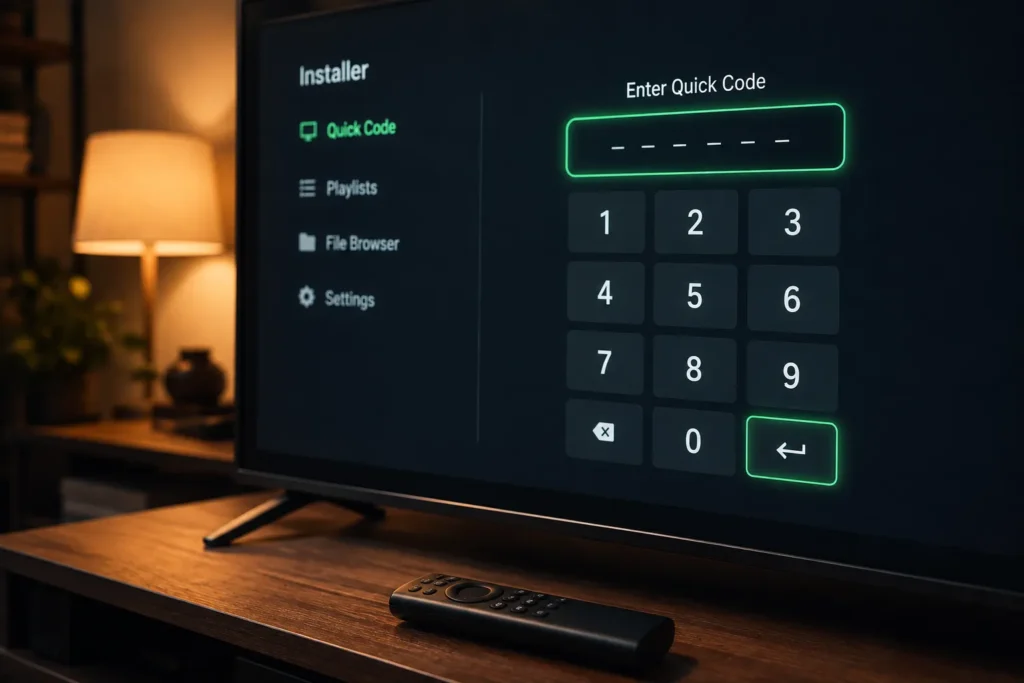
No computer, no USB drive, no forum scavenging. The installation collapses into three moves on Firestick and Android TV, and you will never repeat them—because the app updates itself forever after.
Move One — Downloader by AFTVnews and the Unknown-Apps Switch
Open the store on your device and install Downloader by AFTVnews, the standard tool for sideloading serious software onto streaming hardware. Then grant the permission Android requires: on Firestick, walk to Settings → My Fire TV → Developer Options and enable Install Unknown Apps (older firmware calls it “Apps from Unknown Sources”); on Android TV, the same switch lives under Settings → Security & Restrictions → Unknown Sources. Ninety seconds of tapping, and your device is legally allowed to accept excellence.
Move Two — The Quick Code
Launch Downloader and look at the URL bar. You will not be typing a long address. The platform publishes a short numeric quick code—grab your quick installation code from the homepage or the official guide before you sit down in front of the TV. Enter the code, hit go, and Downloader resolves it straight to the correct build for your hardware. No typos, no mirror sites, no guesswork.
Move Three — Install, Launch, and the Great APK Purge
The code triggers an automatic download of the APK. When the prompt appears, choose Install, then Open to see the interface light up for the first time. Now the move everyone skips and later regrets: return to Downloader’s file list and delete the APK file. The application already lives on your device; the installer is dead weight consuming storage your streaming stick needs for smooth operation. Purge it. Setup is complete, and it took less time than the commercials in one cable break.
The Doubter’s Corner: Eight Questions, Answered Without Hedging
1. Can I watch IPTV for free on a Firestick I bought years ago? Yes. The APK is optimized for low-RAM hardware, so second-generation sticks run it smoothly. Older silicon often handles this client better than the bloated native apps it shipped with.
2. Will the channel list rot the way playlists do? No. Rotation and repair happen server-side. The grid you open tomorrow is the grid the servers consider healthy at that moment—there is nothing on your device left to decay.
3. Do I need a VPN because the servers are offshore? Nothing is required of you. The offshore routing and CDN handoffs already handle the throttling problem at the network layer; the app arrives ready to run as installed.
4. What does the PIN actually hide? Everything adult. Without the code, the category is absent from menus, search, and recommendations—not merely locked, but invisible to anyone holding the remote.
5. How much bandwidth does the engineered path need? Roughly 10–15 Mbps steady for FHD and about 25 Mbps for comfortable 4K. The anti-buffer reserve forgives brief dips that would freeze a generic player.
6. Are there ads injected into the streams? No mid-match detergent breaks, no pre-roll before movies. The streams you receive are the streams as produced.
7. Can the bedroom TV and the living room TV both run it? Yes. There is no hardware binding and no per-device surcharge. Install it on every Firestick and Android TV in the house; the fee remains $0 each time.
8. What happens during server maintenance? You never find out. Failover hands your stream to a healthy node before the maintenance window touches your picture—part of how the uptime ledger stays at 99.9%.
Last Frame: The Remote Is in Your Hand
Trace the signal one more time and the original question answers itself with almost embarrassing clarity. Can i watch iptv for free? You can—when the service owns its servers instead of renting scraped links, when rotation and failover happen in the cloud instead of on your Saturday, and when the business model is scale rather than your card on file. Cable trained you to pay for ballast. Playlists trained you to work for scraps. The engineered path trains you for neither: 20,000+ live channels, a daily-refreshed movie and series wing, 4K and FHD held steady by anti-buffer pre-fetch, offshore routing that leaves throttling asleep, and a monthly fee that does not exist.
Friday night is coming. The difference, this time, is that you already know what the signal’s journey looks like—and whose side it is on. Take the zero-dollar television upgrade, run the three-move deployment, and let the next price hike land on somebody else’s kitchen counter.