Table of Contents
How to get IPTV channels for free: stop renting broken playlists and plug your Firestick or Android TV into a cloud-managed streaming utility. A standalone app connects to offshore backend servers, self-updates 20,000+ live channels and daily 4K VOD, and meters $0 monthly—99.9% uptime, no M3U files, no manual maintenance, ever.
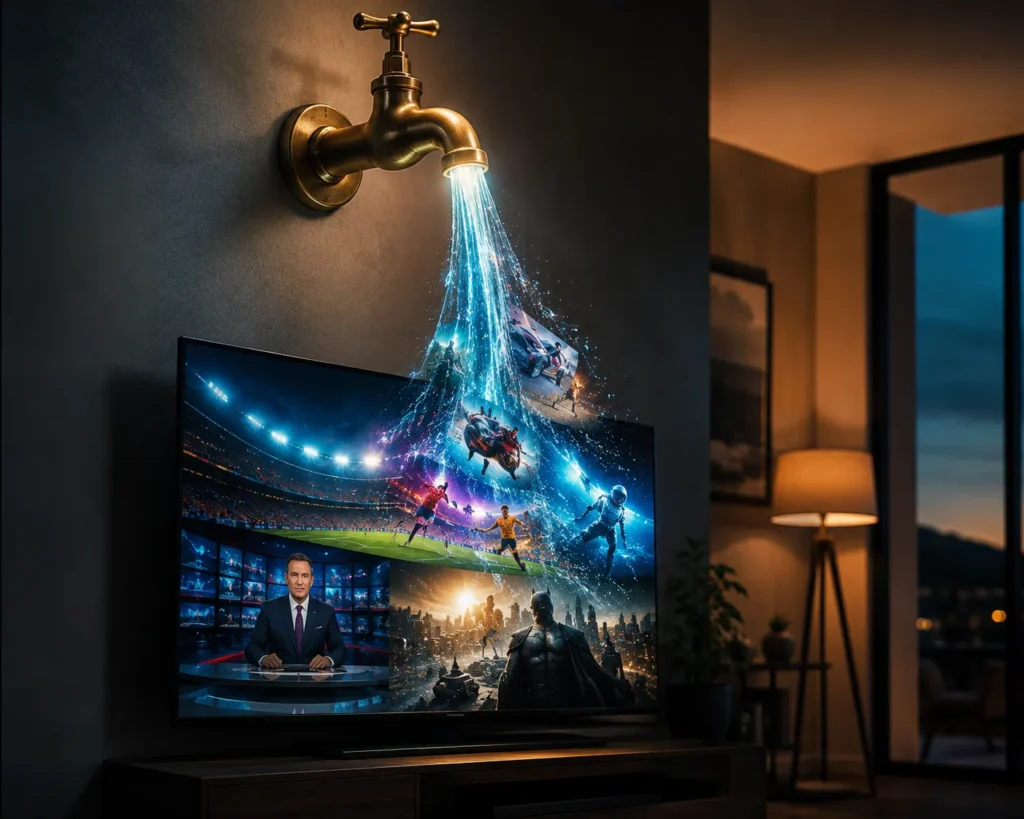
Turn on a tap and you do not think about the reservoir. You do not inspect the pipe, interview the pump, or negotiate with the water. The utility simply delivers, at pressure, whenever you ask. Television was supposed to become that kind of service the day it moved onto the internet. Instead, most households ended up connected to one of two broken plumbing systems: a metered monopoly that charges more every year for watered-down flow, or a bootleg generator sputtering in the garage that dies the moment the whole neighborhood wants power at once. The search query how to get iptv channels for free is, underneath the words, an infrastructure question. It asks: where is the real grid, and how do I plug my house into it?
The answer exists, and it is neither a cable bundle nor a playlist. It is a cloud-managed IPTV utility—a standalone, auto-updating application that connects your Firestick or Android TV directly to managed backend servers, the way a house connects to a power station instead of a borrowed extension cord. This article maps the three systems honestly, then walks the exact three-move service installation that puts the real grid behind your glass.
Exhibit A — The Overpriced Pipe: Cable’s Metered Scam
Cable behaves like a water monopoly that discovered it can charge by the droplet. The statement itemizes the extortion with a straight face: the bundle of one hundred and fifty-plus channels, of which an honest household watches a dozen; the box rental, a monthly lease on hardware the provider purchased years ago and will replace never; the broadcast fee and the regional sports surcharge, tolls on water you already paid for. Then month thirteen arrives—the promotional cliff—and the meter spins faster for the same flow.
Audit the pipe and the scam clarifies. You are not paying for television. You are paying for ballast channels that exist to justify the bundle’s arithmetic, for the privilege of renting a box, and for the inertia of a household that has not yet walked to the breaker panel. Cable is an overpriced scam not because it is expensive, but because the expense buys scarcity: blackouts on the biggest matches, schedules dictated by the provider, and a guide padded with channels nobody asked to fund.
Exhibit B — The Bootleg Generator: Living on Scraped Playlists
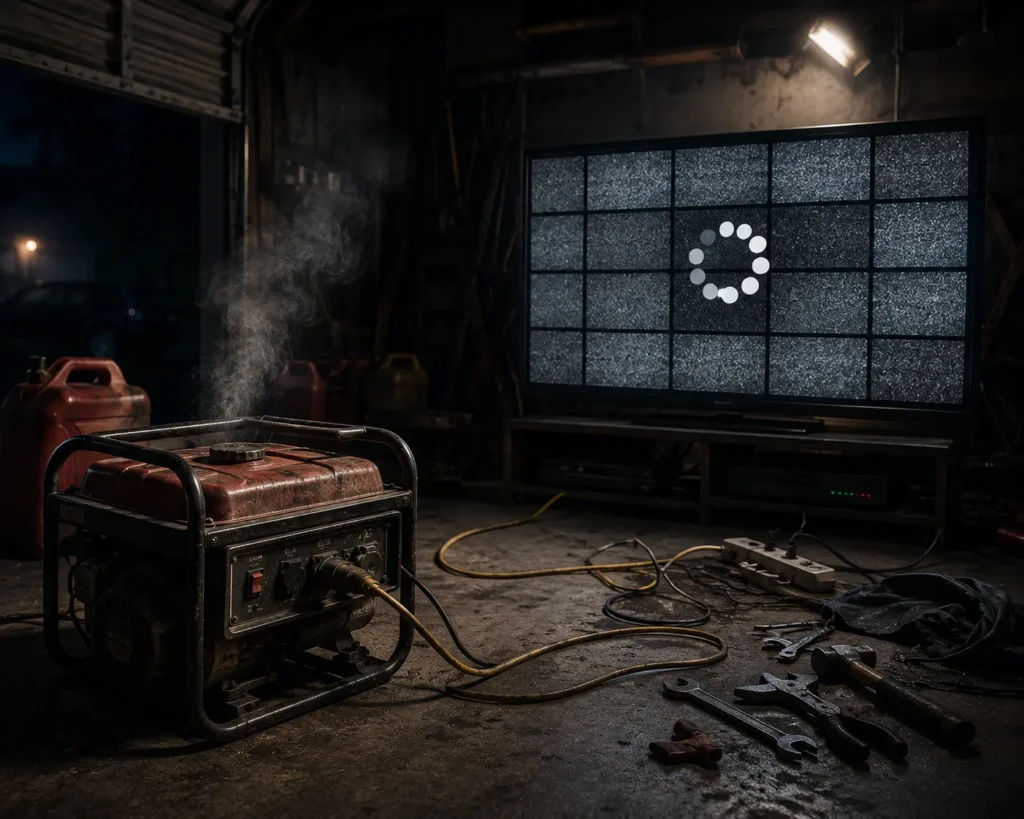
The DIY escape route looks like freedom for exactly one evening. An M3U playlist is a plain-text list of scraped stream addresses pasted into a generic player—the streaming equivalent of a portable gasoline generator wired into the house with extension cords. It hums. The lights come on. Then the physics arrive.
The 24-Hour Fuel Cycle
Host servers rotate addresses and tokens daily to dodge detection and shed load, so a scraped list carries a built-in expiration. Friday’s working grid becomes Saturday’s wall of gray tiles. You did nothing wrong; the fuel was stale when you bought it.
Brownouts at Peak Demand
A generator sized for one family cannot carry the whole street. When hundreds of strangers hammer the same unmanaged host, the voltage sags precisely at the moment of the final whistle—buffering wheels, frozen frames, resolution collapsing to soup. Peak demand is when you most want power, and it is exactly when the bootleg setup fails.
Maintenance Falls on You
Generators need a mechanic, and the playlist’s mechanic is you. Hunt a fresh link at midnight. Paste it. Test tile by tile. Rebuild the electronic program guide when it rusts into wrong times and blank slots. Repeat weekly. The monetary invoice reads $0; the true invoice is every Saturday you spend keeping the lights on. A leak has no maintenance department, and a playlist is a leak.
The Real Grid: Inside a Cloud-Managed Television Utility
The genuine answer to how to get iptv channels for free is a utility built like one: centralized intake, engineered distribution, stored reserves, and a meter that reads zero. The standalone application is merely the socket in your wall; the power station is a fleet of managed backend servers doing every task the playlist era dumped on households.
Offshore Intake: Where Throttling Cannot Reach
Domestic ISPs shape and throttle recognized streaming traffic, sagging your voltage precisely during prime time. The grid’s intake sits on offshore servers whose traffic signatures the throttling systems fail to recognize. Your request leaves the country, finds the content, and returns disguised as ordinary encrypted flow. The throttle never wakes up.
The CDN Distribution Network: Pressure That Never Drops
One server cannot carry fifty thousand households, so the grid never asks it to. A global CDN network replicates the flow across edge nodes and hands your device the nearest healthy one. If a node develops a hiccup mid-broadcast, the client switches to healthier pressure in milliseconds—no spinner, no crash, no reboot ritual. This load-balancing mesh is what makes 99.9% server uptime a physical fact instead of a slogan.
Anti-Buffer Reservoirs: Stored Seconds
Buffering is simply the tap asking faster than the pipe delivers. Anti-buffer technology keeps a reservoir: video segments pre-fetched seconds ahead of playback, held in memory. A momentary network dip is absorbed by the reserve instead of appearing on your screen, which is how 4K and FHD hold their frame rate through the final minute—the minute bootleg generators always lose.
The Meter That Reads Zero
Here is the scoreboard, read aloud: $0 monthly fees, with no card field, no trial countdown, no premium tier waiting to upsell you; 50,000+ active users, the scale that amortizes enterprise infrastructure until the household bill becomes unnecessary; 99.9% uptime, held by the mesh above; 20,000+ live channels plus a daily-updated VOD library, maintained server-side on a schedule, not a promise. Zero is not the promotion. Zero is the engineering outcome.
“Households keep asking us whether their stick is powerful enough, and we keep answering that it is the wrong meter. The socket does not need to be a power station. When intake, distribution, and reserves live in the fleet, the living room device goes back to being what it should always have been—a tap.” — Grid Operations Lead, FREE IPTV CHANNELS
What Flows Through the Pipes: The Twelve-District Library
Pressure means nothing if the water tastes wrong, so the grid is shelved the way households actually drink. Browse the full twelve-district channel library and you move through a lineup deeper than any bundle it replaces:
- Live Sports — league nights, combat cards, motorsport weekends, and the overseas feeds domestic packages blackout.
- Latest Movies — theatrical newcomers and catalog classics, added daily, served without pre-roll ads.
- Premium TV Series — complete seasons in order, commercial-free, episodes arriving on schedule.
- Adult Content — the restricted district, documented below.
- Live News — domestic and international 24-hour coverage without padded affiliate breaks.
- Documentaries — nature, history, true crime, and science strands for slow evenings.
- International — diaspora broadcasting in dozens of languages, from European public networks to Latin American and Asian staples.
- Kids & Family — a walled, age-safe district that never leaks mature tiles into the main grid.
- Music & Arts — concert feeds, video blocks, and gallery programming.
- Gaming & Tech — esports tournaments, hardware channels, and builder culture.
- Lifestyle & Food — cooking, travel, home, and design.
- Drama & Comedy — the syndicated backbone of comfortable background television.
The restricted district behaves the only acceptable way in a shared household: PIN-protected, and stronger still, invisible. Without the code you set, the category appears in no menu, no search result, no recommendation rail. Locked is common. Invisible is engineered.
Connecting Your House: The Three-Move Service Installation
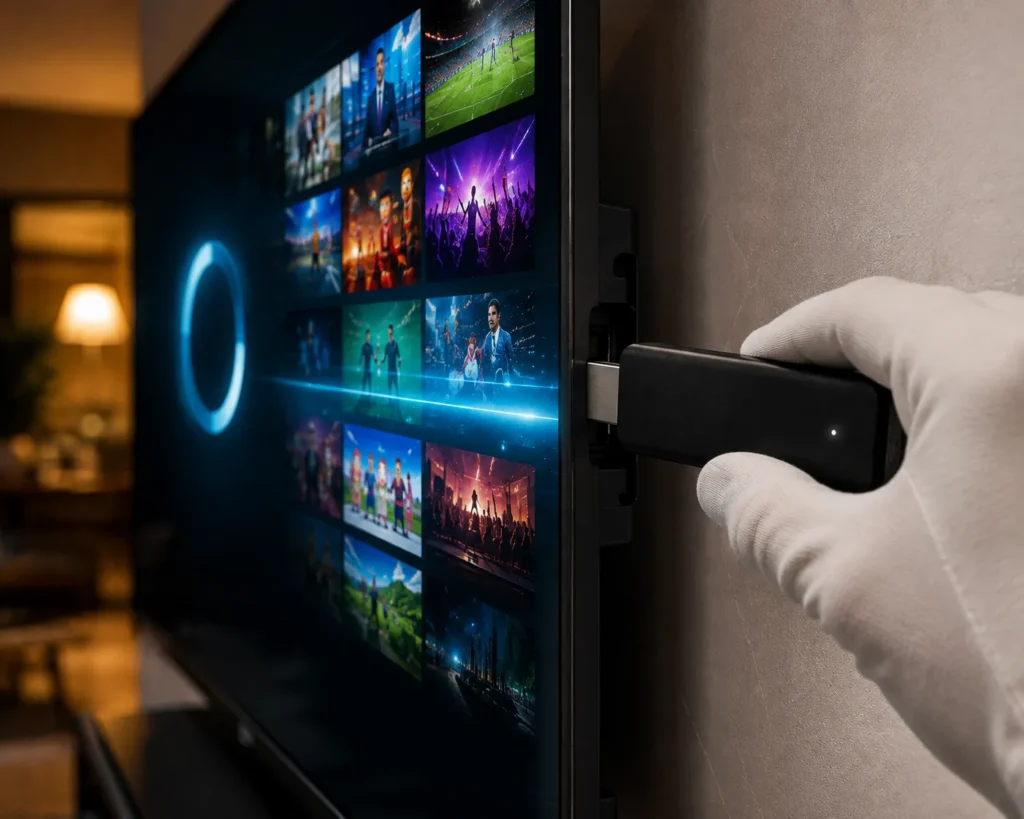
No computer, no phone tethered by cable, no USB talisman. The connection runs on the stick, with its own remote, in three moves and under five minutes—shorter than one cable commercial break.
Move 1 — Fetch Downloader and Open the Panel
Install Downloader by AFTVnews from the device store, the community-standard utility for sideloading serious software. Then open the permission panel the manufacturer built into the firmware: on Firestick, Settings → My Fire TV → Developer Options → Install Unknown Apps (older firmware labels it “Apps from Unknown Sources”); on Android TV, Settings → Security & Restrictions → Unknown Sources. This is not a jailbreak. It is the homeowner opening his own breaker panel.
Move 2 — Enter the Quick Code
Open Downloader and face the URL bar. You will not type an address. The utility publishes a short numeric code—collect the current quick installation code from the homepage or the official guide before you sit down—and the digits resolve straight to the correct build for your hardware. No long strings to mistype, no mirror sites to vet, no guesswork. Type, go, watch the bar fill.
Move 3 — Install, Open, and Coil Up the Extension Cord
The code triggers the auto-download of the APK. Choose Install, then Open to see the grid light up already current. Final move, the one veterans never skip: return to Downloader’s file list and delete the APK file. The application lives on your device now; the installer is a coiled extension cord taking up a closet your stick needs for storage. Purge it. Keep the closet.
Service note: Because there is no hardware binding and no per-device surcharge, every Firestick and Android TV in the house gets the same connection and the same $0 meter. Plug each socket; the bill stays zero.
Service Questions: The Utility FAQ
1. How to get iptv channels for free without a card or email? Exactly as the installation section describes: download, install, open. No payment field, no registration wall, no trial countdown converting into an invoice. $0 is the structure, not the promotion.
2. Will I ever paste a link or rebuild a guide again? Never. Rotation, token refresh, and guide synchronization execute server-side, continuously. The grid you open is always the grid the fleet considers healthy at that moment.
3. My ISP throttles streaming at night. Will I feel it? Peak windows are precisely what the offshore intake, CDN mesh, and anti-buffer reservoirs were built to defeat. The throttle hunts recognizable signatures; your flow does not present one.
4. How much bandwidth does the grid need at my socket? Roughly 10–15 Mbps steady for FHD and about 25 Mbps for comfortable 4K, ideally over 5 GHz Wi-Fi or ethernet. The reservoir forgives brief dips that freeze generic players.
5. Is the restricted district truly invisible without the PIN? Measured, not promised. Without your code, the category appears nowhere—no tile, no search hit, no accidental recommendation.
6. Will Fire OS or Android TV updates break the connection? The client is standalone and self-updating through its cloud backend. Operating system updates and channel rotation are separate universes; one does not vandalize the other.
7. Are there ads injected into the flow? No mid-match detergent breaks, no pre-roll before movies. The streams arrive as produced; a thousand household logs would confirm the silence.
8. What happens during server maintenance? You never find out. Failover hands your stream to a healthy node before the window touches your picture—part of how the uptime meter stays at 99.9%.
Switching Day: Cut the Old Pipe, Open the Tap
Read the three exhibits one final time and the original question answers itself with plumbing-level clarity. How to get iptv channels for free? Not by staying on the metered monopoly that prices you as a captive. Not by adopting the bootleg generator that prices you as its mechanic. By connecting to the real grid: offshore intake that leaves throttling asleep, a global CDN that never drops pressure, anti-buffer reservoirs that hold 4K steady through the final whistle, 20,000+ live channels and a daily-refreshed VOD wing flowing through twelve organized districts, 99.9% uptime, 50,000+ households already on the line, and a monthly meter that reads exactly zero.
The tap is installed in five minutes and maintained forever by the fleet. Open the zero-bill television service tonight, run the three-move connection, and let the next promotional cliff raise prices on somebody else’s street.