
Table of Contents
Free live stream IPTV works only when the platform owns the present tense: a standalone cloud app whose offshore servers and global CDN hand your Firestick or Android TV the nearest healthy edge, protecting the exact second of the goal with anti-buffer reservoirs—20,000+ live channels, daily 4K VOD, $0 monthly, 99.9% uptime.
Every word in the query matters, but one word does the lifting: live. Not catalogued, not scheduled, not “available tomorrow”—live, the present tense, the thing happening while you watch it. Live is the hardest word in streaming, because it is the only content that cannot be retried. A movie can buffer and resume; a series can pause. A goal, a knockout, a verdict, a launch—these arrive once, at one second, to fifty thousand sofas at once, and any platform that cannot honor that second is not delivering live television. It is delivering a rumor of it. The search free live stream iptv is therefore a demand for physics, not a bargain hunt: it asks for infrastructure that can carry the present tense, for free, to the stick in your HDMI port. That infrastructure exists, and it is a cloud-managed live stream platform—a standalone, auto-updating application that connects directly to offshore backend servers and treats your screen as the final stop of a planetary relay built for exactly one job: arriving on time.
This piece is about the physics of now. It covers the three fates that kill scraped “live” streams, the tollbooth cable erects at the stadium gate, the engineering that protects the second, the twelve districts where everything happens at once, a single goal experienced across fifty thousand living rooms, the three-move protocol for joining the present, and the questions the moment raises.
Delayed, Frozen, Dead: The Three Fates of a Scraped Live Stream
An M3U playlist is a plain-text list of scraped stream addresses pasted into a generic player, and “live” is precisely where its physics fail first. The testimony is consistent in every collected log, and it always ends in one of three fates.
Fate One: Delayed
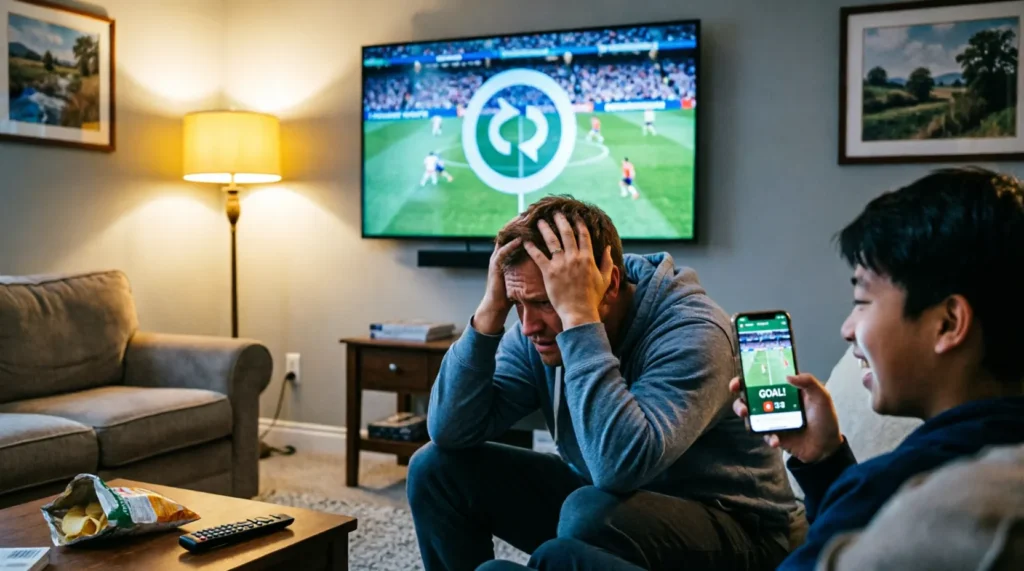
A scraped host sits behind no load balancer and no edge network, so your request joins a queue that spans continents. The result is the cruelest form of failure: the lag. The neighborhood roars at the goal forty seconds before your screen shows the buildup. A phone in the other room spoils the knockout. You are not watching live; you are watching the past at a variable delay, and the delay is widest exactly when the event is biggest—because queues grow with crowds.
Fate Two: Frozen
When the crowd peaks, the single-lane host chokes. The feed stalls at the exact second of the final whistle; the buffering wheel spins over the moment you refused cable to see. Resolution collapses to soup, frames arrive out of order, and the “live” badge on the player becomes a small lie in the corner of your screen. Peak demand is when you most want the present tense and exactly when the bootleg pipe loses it.
Fate Three: Dead
Host servers rotate addresses and tokens daily to dodge detection and shed load, producing the 24-hour crash: Friday’s working feed is Saturday’s wall of gray tiles. Then the labor invoice arrives—hunt the link, paste it, test tile by tile, rebuild the guide, repeat weekly. The monetary cost is $0; the true cost is every Saturday spent servicing a queue you joined for free. A playlist cannot carry the present tense because it cannot even carry last week’s.
The Tollbooth at the Stadium Gate
Cable fails the present tense by business model rather than physics. The bundle is a walled garden priced like a car payment for a dozen watched channels, padded with the box rental, the broadcast fee, the regional surcharge, and the promotional cliff at month thirteen. And when the moment arrives—the away match, the playoff, the derby—the tollbooth slams down: regional blackouts on the exact feeds you paid for, “premium tier” migrations on the channels that carry the finals, and a delay of its own, because the legacy pipeline was never engineered for the second either. Cable sells you the present tense and delivers it late, censored, and itemized. It is an overpriced scam not because the number is high, but because the number buys absence at the only moment that mattered.
Engineering the Now: How a Cloud Fleet Delivers the Present Tense
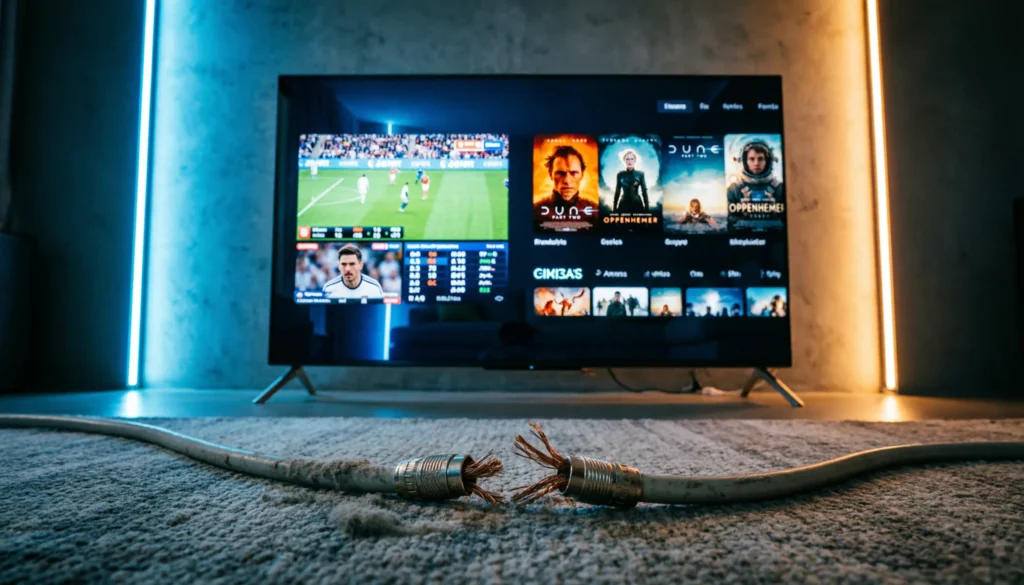
The genuine platform inverts both failures. It is a compiled, standalone application that connects directly to managed backend servers, and every burden the scraped era dumps on users—rotation, token refresh, dead-stream surgery, guide synchronization—executes server-side, continuously, invisibly. But the part that matters for live is the relay itself.
The Sub-Second Handoff
Streams originate on offshore servers whose traffic signatures domestic ISP throttling fails to recognize, so the match-time throttle never wakes up. A global CDN network replicates every live feed across edge nodes on multiple continents and hands your device the nearest healthy one. If a node develops a bottleneck mid-match, the client switches to a healthier edge in milliseconds—no spinner, no crash, no reboot ritual. This mesh is what makes 99.9% server uptime a physical fact, and it is what collapses the queue: you are never fortieth in line behind a single host, because there is no single host.
The Reservoir That Protects the Moment
Latency and loss are absorbed before they reach the glass. Anti-buffer technology keeps a reservoir of pre-fetched segments seconds ahead of playback, so a Wi-Fi blink, a router hiccup, a neighborhood surge is eaten by the reserve instead of appearing as a wheel over the goal. Resolution holds at 4K and FHD through the final minute—the minute scraped pipes always lose. And the ledger that makes the relay affordable reads like an endowment: 50,000+ active users amortize enterprise infrastructure until the household bill becomes unnecessary—$0 monthly fees, no card field, no trial countdown, no premium tier waiting at the gate.
“People measure a live platform by its average night, and that is the wrong instrument. The only measurement that matters is the ninetieth minute of the biggest match of the year, fifty thousand households at once. Everything we built—the mesh, the reservoirs, the failover—exists for that one second.” — Principal Broadcast Engineer, FREE IPTV CHANNELS
Everything Happening at Once: The Twelve Live Districts
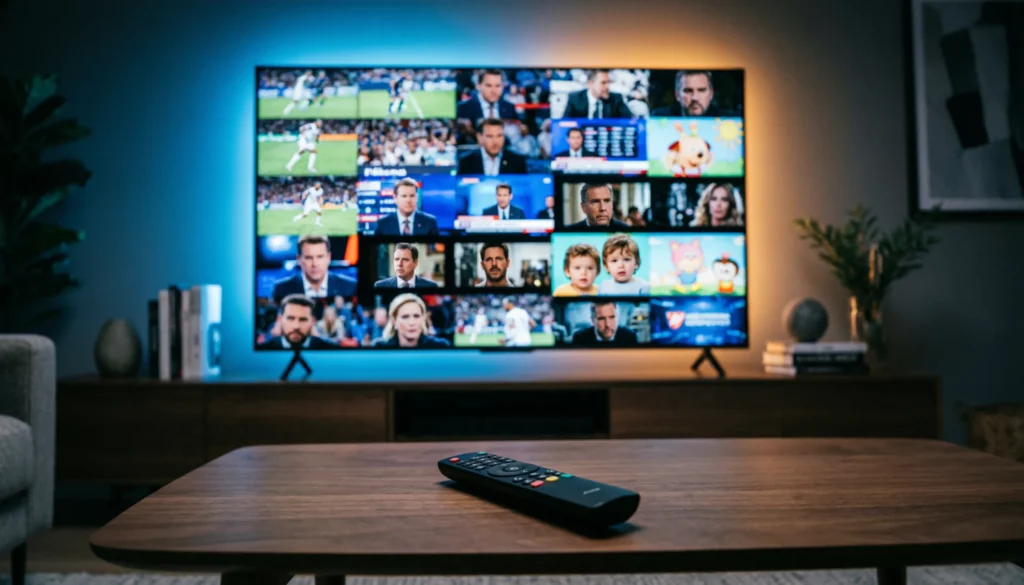
Depth without organization is noise, so the present tense is shelved the way households actually live it. Browse the twenty-thousand-channel live grid and you move through twelve districts, plus the not-now wing—a VOD library of movies and series refreshed daily for the hours when you choose the tense yourself:
- Live Sports — the flagship of now: league nights, combat cards, motorsport weekends, and the overseas feeds domestic packages blackout, served at the second.
- Live News — breaking coverage as it breaks, domestic and international, without padded affiliate delays.
- Latest Movies — theatrical newcomers and catalog classics, added daily, served without pre-roll ads.
- Premium TV Series — complete seasons in order, commercial-free, episodes arriving on schedule.
- Adult Content — the restricted district, strictly PIN-protected and invisible without your code.
- Documentaries — nature, history, true crime, and science strands for slow evenings.
- International — diaspora broadcasting in dozens of languages, live on every continent’s clock.
- Kids & Family — a walled, age-safe shelf that never leaks mature tiles into the main grid.
- Music & Arts — concert feeds and gallery programming, live as performed.
- Gaming & Tech — esports tournaments and hardware channels at match pace.
- Lifestyle & Food — cooking, travel, home, and design from five continents.
- Drama & Comedy — the syndicated backbone of comfortable background television.
The restricted district behaves the only acceptable way in a shared household: PIN-protected, and stronger still, invisible. Without the code you set, the category appears in no menu, no search result, no recommendation rail. Locked is common. Invisible is engineered.
One Second, Fifty Thousand Sofas
The physics are best proven by a single moment. Ninety-third minute, one goal, and the fleet’s logs read like a heartbeat:
- T-minus 0 — the strike. Fifty thousand households request the same segment within the same second.
- The mesh — no single host feels the crowd; edge nodes on four continents absorb the surge, each sofa handed its nearest healthy node.
- The blink — in one living room, the Wi-Fi dips for ninety seconds; the reservoir absorbs it, and the screen never learns.
- The handoff — one edge node develops a bottleneck; streams are handed to healthier nodes in milliseconds; no spinner anywhere in the log.
- The roar — the same second, fifty thousand sofas. No phone spoils it. No wheel interrupts it. No blackout itemizes it.
- The audit — weekly tally in green: zero buffer events at peak, zero dead tiles, zero maintenance minutes, zero dollars. The present tense, delivered.
Joining the Present: The Three-Move Protocol
No computer. No phone tethered by cable. No USB talisman. The joining runs on the stick, with the stick’s own remote, in three moves and under five minutes—shorter than the pre-match ad break you are about to abolish.
Move 1 — Fetch Downloader and Open the Panel
Install Downloader by AFTVnews from the device store, the community-standard utility for sideloading serious software. Then open the permission panel the manufacturer built into the firmware: on Firestick, Settings → My Fire TV → Developer Options → Install Unknown Apps (older firmware labels it “Apps from Unknown Sources”); on Android TV, Settings → Security & Restrictions → Unknown Sources. This is not a jailbreak. It is the owner of a computer exercising a printed permission.
Move 2 — Enter the Quick Code
Open Downloader and face the URL bar. You will not type an address. The platform publishes a short numeric code—collect the live-grid quick installation code from the homepage or the official guide before kickoff—and the digits resolve straight to the correct build for your hardware. No long strings to mistype, no mirror sites to vet, no guesswork. Type, go, watch the bar fill.
Move 3 — Install, Open, and Cut the Delay Cord
The code triggers the auto-download of the APK. Choose Install, then Open to see the grid light up already current. Final move, the one veterans never skip: return to Downloader’s file list and delete the APK file. The application lives on your device now; the installer is dead weight taking up storage your stick needs for smooth operation. Purge it. Keep the stick lean.
Household note: There is no hardware binding and no per-device surcharge. Every Firestick and Android TV in the house joins the same second at the same $0 fare—the living room, the bedroom, the garage workshop. Seat every screen.
Questions About the Now: Answered at the Moment
1. What counts as “live” here, versus a delayed stream? Feeds are carried at the second through the edge mesh—no queue behind a single host, no legacy pipeline lag. The neighborhood and your sofa roar together.
2. Will my phone spoil the goal before my TV shows it? That symptom belongs to delayed pipes. With the mesh and reservoirs, the screen keeps pace with the street; the spoiler dies.
3. Does joining require a card or an email? No payment field, no registration wall, no trial countdown. Download, install, open. $0 is the structure, not the promotion.
4. My ISP throttles streaming at match time. Will the second survive? Peak windows are precisely what offshore origination and the CDN mesh were built to defeat. The throttle hunts recognizable signatures; your traffic does not present one.
5. How much bandwidth does live 4K need? About 25 Mbps downstream for comfortable 4K; 10–15 Mbps serves FHD superbly. Feed the stick 5 GHz Wi-Fi or ethernet and the reservoir forgives the rest.
6. Is the restricted district truly invisible without the PIN? Measured, not promised. Without your code, the category appears nowhere—no tile, no search hit, no accidental recommendation.
7. Can two screens watch the same match in the same second? Every Firestick and Android TV you own runs the same $0 fare with no hardware binding. Two sofas, one goal, one second.
8. Will Fire OS or Android TV updates break the app? The client is standalone and self-updating through its cloud backend. Operating system updates and channel rotation are separate universes; one does not vandalize the other.
The Final Whistle: The Present Tense Is a Remote in Your Hand
Read the physics one last time and the original query resolves into an instruction. Free live stream iptv? Not from the scraped pipe that delivers the past at a variable delay and dies at the whistle. Not from the toll road that blackouts the moment and itemizes the absence. You join the fleet: offshore intake that leaves every throttle asleep, a planetary CDN that never lets a crowd choke a second, anti-buffer reservoirs that hold 4K steady through the ninetieth minute, 20,000+ live channels and a daily-refreshed VOD wing across twelve organized districts, 99.9% uptime, 50,000+ sofas already in sync, and a monthly fee that does not exist.
The moment arrives once. Take the permanent seat at the live edge, run the three-move protocol before kickoff, and let the next buffering wheel spin over somebody else’s final whistle.