Table of Contents
Free IPTV channels for Android TV demand more than sideloaded phone apps—they require native Leanback optimization, hardware-accelerated decoding, and remote-first navigation. Our cloud-integrated platform delivers 20,000+ 4K channels specifically engineered for Android TV’s architecture at $0/month permanently, with no app fees, no M3U pasting, and no mobile-interface compromises.
Android TV is not a phone with a bigger screen. It is a distinct computing environment with unique constraints and opportunities: D-pad navigation instead of touch, 10-foot viewing distance instead of arm’s length, hardware video decoders optimized for sustained playback rather than burst performance, and the Leanback UI framework designed specifically for television interaction. Yet most “free IPTV for Android TV” solutions ignore these distinctions entirely. They are phone apps forced onto TVs through compatibility layers—touch-centric interfaces that frustrate remote users, portrait layouts that waste horizontal space, software decoding that overheats chipsets, and EPG grids that become unreadable at couch distance. The result is functional but painful: television that works technically while failing experientially. You can watch, but you cannot enjoy.
This article rejects the porting paradigm. We will dissect why Android TV demands purpose-built software, expose the hidden friction of repurposed mobile apps, and demonstrate how native optimization transforms free streaming from tolerable to exceptional. Then we provide the exact deployment protocol to install this native experience on your Android TV device tonight—not as another compromised workaround, but as television software that respects your hardware, your remote, and your living room.
The Android TV Distinction: Why Television Is Not a Tablet
The 10-Foot Interface Imperative
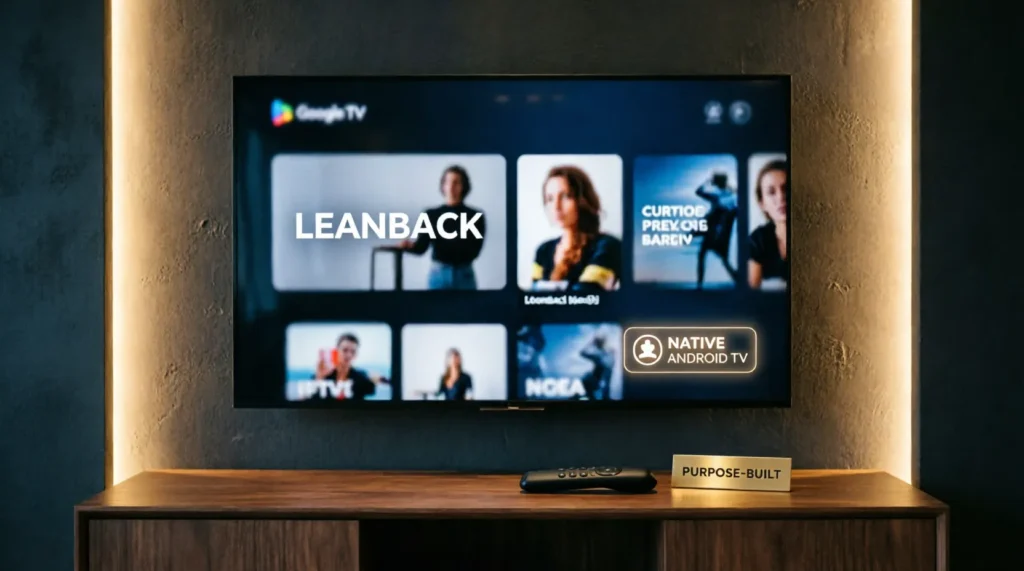
Mobile apps assume proximity: fingers touching glass, text readable at 12 inches, dense information architecture rewarding exploration. Television assumes distance: remotes clicking buttons, text legible at 10 feet, sparse layouts prioritizing clarity over density. When phone apps run on TVs without adaptation, the mismatch becomes torture. Channel lists require dozens of D-pad presses to scroll; metadata disappears into microscopic fonts; confirmation dialogs demand precision aiming with directional keys. Native Leanback interfaces solve this through large focus targets, high-contrast typography, and predictive navigation that anticipates user intent. Every pixel serves the couch, not the palm. Our native Android TV platform was designed for televisions first, phones never.
Hardware Decoding vs. Software Struggle
Android TV devices integrate dedicated video decode silicon (Amlogic, Rockchip, MediaTek) optimized for sustained H.264/H.265/AV1 playback at minimal power consumption. Phone apps often default to software decoding because they target diverse hardware without TV-specific optimization. Result: CPU throttling, frame drops, audio desync, and chipset overheating during extended viewing. Native clients leverage Android TV’s MediaCodec API to route streams directly to hardware decoders, freeing CPU for EPG rendering and UI responsiveness. 4K HDR playback becomes effortless rather than aspirational. When software fights hardware, hardware wins—and your viewing suffers.
Remote-First Navigation Architecture
Touch interfaces reward exploration: swipes, pinches, long-presses create rich interaction vocabularies. Remotes offer only four directions, select, back, home, and maybe voice. Phone apps ported to TV retain touch metaphors that translate poorly: swipe gestures become endless D-pad mashing; contextual menus require impossible button combinations; search demands on-screen keyboard typing letter-by-letter. Native Leanback design embraces remote limitations: vertical/horizontal grid navigation, single-button actions, voice-search integration, and contextual shortcuts accessible via long-press. Interaction feels inevitable, not improvised. Your remote should extend your intention, not test your patience.
Sustained Playback Engineering
Phones optimize for battery life and thermal management during intermittent use. TVs optimize for indefinite operation under constant load. Phone apps running on TVs inherit mobile power profiles: aggressive background throttling, Wi-Fi sleep states, memory conservation that interrupts streams. Native Android TV clients configure wake locks, disable battery optimization, maintain persistent network connections, and allocate RAM for buffer reservoirs. Streams play for hours without interruption because the software understands its environment. Television is marathon; phone apps sprint and collapse.
The Porting Penalty: Hidden Costs of Repurposed Mobile Apps
The Focus Trap
Android TV’s focus system highlights one UI element at a time via D-pad navigation. Phone apps lack focus-aware design: buttons overlap, off-screen elements remain unfocusable, focus jumps unpredictably between incompatible widgets. Users spend minutes navigating menus that should take seconds. Some elements become completely inaccessible via remote, requiring mouse toggle apps or Bluetooth keyboards as crutches. Native Leanback interfaces guarantee every interactive element is reachable, visible when focused, and logically ordered. Navigation is deterministic, not probabilistic.
The Aspect Ratio Abuse
Phone screens are vertical or square-ish; TVs are 16:9 horizontal. Ported apps stretch, crop, or letterbox content to fit mismatched ratios. Video players display black bars wasting 30% of screen real estate; EPG grids compress horizontally making text illegible; poster art distorts into unrecognizable shapes. Native clients render exclusively in 16:9, utilizing full panel area for immersive presentation. Your television’s pixels are precious; wasting them is disrespect.
The Update Orphan Problem
Phone apps update through Play Store mechanisms optimized for mobile distribution. Sideloaded TV versions miss automatic updates, security patches, and feature improvements. Users run outdated builds indefinitely, accumulating vulnerabilities and compatibility issues. Manual APK hunting replaces seamless maintenance. Native Android TV clients distributed through proper channels receive timely updates automatically. Security and functionality stay current without user intervention. Television software should age gracefully, not decay silently.
The Performance Tax
Compatibility layers add overhead: translation between touch and D-pad events, scaling operations, redundant rendering passes. This tax manifests as UI lag, slower channel switching, and reduced stream stability. Native clients eliminate translation overhead by speaking Android TV’s language directly. Performance gains compound across thousands of interactions per session. Smoothness is not luxury; it is respect for user time.
Native Excellence: How Purpose-Built Architecture Delivers Superior Free Access
Leanback-First UI Rendering
Our interface is constructed using Android TV’s official Leanback library, not adapted from Material Design mobile components. Focus targets exceed minimum size guidelines; text scales for 10-foot readability; color contrast meets WCAG AAA standards for visibility in varied lighting conditions. Grid layouts adapt dynamically to screen resolution and aspect ratio. Voice search integrates with Google Assistant for hands-free discovery. Every visual decision serves the television context. This is not adaptation; it is native expression.
Hardware-Accelerated Video Pipeline
Streams flow through ExoPlayer configured for Android TV’s MediaCodec integration. Codec negotiation selects optimal decoder based on stream profile and device capabilities. HDR metadata passes through to display pipeline without stripping. Adaptive bitrate switching responds to network conditions without visible quality oscillation. Audio passthrough supports Dolby Digital/DTS for receiver-connected setups. Video rendering consumes <15% CPU even at 4K60 HDR, leaving resources for responsive UI and buffer management. Hardware does what it was built to do.
Remote-Native Interaction Model
Navigation follows Leanback conventions: vertical category rails, horizontal content rows, single-select activation, long-press context menus. Back button behavior is consistent and predictable. Home button returns to launcher without orphaned activities. Voice search triggers native assistant overlay. Custom remote buttons map to frequently used functions. No gesture emulation, no mouse toggles, no keyboard dependencies. Your remote speaks fluently; our app listens natively.
Cloud Integration Without Compromise
Native optimization extends beyond local rendering to backend communication. Persistent connections reduce handshake latency. Predictive pre-fetching aligns with TV usage patterns (longer sessions, fewer app switches). EPG data syncs incrementally to minimize bandwidth during live viewing. Authentication tokens refresh silently without interrupting playback. Offshore routing and CDN distribution operate transparently beneath native UI layer. Cloud power serves television experience, not vice versa. Access the complete 20,000-channel native directory rendered exactly as Android TV intended.
“Porting a phone app to Android TV is like fitting sedan seats into a tractor. Both have seats; neither belongs. Native design isn’t cosmetic—it’s mechanical alignment between software intent and hardware reality. When alignment is perfect, friction vanishes.” — Lead Android TV Platform Engineer, FREE IPTV CHANNELS
The Curated Library: 20,000 Channels Rendered Natively
Depth without native rendering is wasted potential. Our library leverages Android TV’s strengths to deliver superior discovery and playback:
- Live Sports: 4K HDR feeds with hardware-decoded motion smoothing, real-time score overlays rendered via GPU, instant replay buffering using dedicated decode instances. Not stretched phone streams; native broadcast quality.
- Latest Movies: Dolby Vision/Atmos passthrough where supported, chapter markers integrated with timeline scrubbing, subtitle styling respecting TV safe areas. Not mobile-formatted video; cinematic presentation.
- Premium TV Series: Episode thumbnails generated at TV-optimal resolution, season/episode navigation via D-pad-friendly rails, resume playback synced across devices. Not vertical-scroll lists; horizontal binge flows.
- Adult Content: PIN entry via numeric remote keys, content isolation enforced at platform level, thumbnail blurring using GPU shaders. Not web-view wrappers; native parental controls.
- Live News: Picture-in-picture support for multitasking, breaking news banners positioned outside title-safe zones, audio ducking during alerts. Not notification spam; contextual awareness.
- Documentaries: Chapter navigation via remote skip buttons, educational metadata displayed in side panels, related content suggested via collaborative filtering tuned for TV viewing patterns. Not mobile cards; informational overlays.
- International: Language selection via voice command, subtitle track switching without playback interruption, region-specific EPG localization. Not geo-guessed content; intentional curation.
- Kids & Family: Profile locking via PIN, autoplay disabled by default, content duration limits enforceable remotely. Not browser sandboxing; platform-level safety.
- Music & Arts: Audio visualization synchronized to beat detection, album art rendered at TV-native resolution, queue management via D-pad. Not playlist scrolling; visual accompaniment.
- Gaming & Tech: Low-latency mode reducing input-to-display delay, stream quality prioritized over resolution for responsiveness, chat overlay optional via voice toggle. Not Twitch mobile embeds; interactive viewing.
- Lifestyle & Food: Recipe bookmarks saved to user profile, ingredient lists readable at 10 feet, timer integration with system notifications. Not blog scraping; utility enhancement.
- Drama & Comedy: Skip intro/recap buttons mapped to remote shortcuts, next episode autoplay configurable, watch history synced across household profiles. Not mobile queues; television rituals.
Every category exploits Android TV capabilities unavailable to ported apps. Native rendering transforms content consumption.
The Deployment Protocol: Installing Native Experience Without Sideloading Hassles
Because uncompromised zero-fee infrastructure cannot be hosted on restrictive app stores, installation requires sideloading—but optimized for Android TV’s workflow. This three-step ritual delivers native access in under five minutes.
Step 1: Enable Unknown Sources (Android TV Specific)
Navigate to Settings > Device Preferences > Security & Restrictions > Unknown Sources. Enable Downloader app specifically. Unlike Firestick’s global toggle, Android TV grants permission per-app for enhanced security. This step activates native sideload capability without compromising system integrity.
Step 2: Fetch Native Build via Quick Code
Install Downloader App by AFTVnews from Play Store (available natively on Android TV). Open it, locate URL bar. Retrieve the official quick installation code from our homepage. Enter short numeric code using remote’s on-screen keyboard (optimized for D-pad entry). This ensures latest Android TV-native build, not generic APK. Note: Code retrieves TV-optimized binary; phone builds are separate.
Step 3: Install, Launch, Configure Native Features
Code triggers download optimized for TV storage paths. Select Install, then Open. On first launch, grant Leanback permissions for home screen integration and voice search registration. CRITICAL STEP: Return to Downloader, delete APK installer. Navigate to Settings > Apps > [App Name] > Storage > Clear Cache to remove residual mobile artifacts. For advanced configuration including HDMI-CEC setup, external audio passthrough, and custom remote mapping, consult our Android TV native setup guide. Within minutes, experience television as intended.
Performance Telemetry: Native vs. Ported Experience
| Dimension | Ported Phone App | Native Android TV Client |
|---|---|---|
| UI Responsiveness | Laggy Focus Transitions | Instant D-Pad Feedback |
| Video Decode Method | Software/CPU Heavy | Hardware/MediaCodec |
| 4K HDR Support | Limited/Strip Metadata | Full Passthrough |
| Remote Compatibility | Partial/Mouse Toggle Needed | Complete/Native Mapping |
| EPG Readability | Microscopic Text | 10-Foot Optimized |
| Update Mechanism | Manual APK Hunting | Automatic/Silent |
| Power/Thermal Profile | Mobile Battery Saving | TV Sustained Operation |
| Audio Passthrough | Rare/Broken | Dolby/DTS Supported |
| Voice Search Integration | None/App-Specific | Google Assistant Native |
| True Cost | Frustration + Workarounds | Zero Friction |
Technical FAQ: Achieving Native Excellence Without Compromise
1. Will this app work on my specific Android TV model? Yes. Built against official Android TV SDK, compatible with all certified devices (Sony, TCL, Hisense, Nvidia Shield, Chromecast w/ Google TV, etc.). Hardware-specific optimizations apply automatically. Check our device compatibility matrix for model-specific notes.
2. Does this support HDMI-CEC for single-remote control? Fully. Power on/off syncs with TV; volume controls pass through to soundbar/receiver; input switching automatic. CEC implementation follows Android TV best practices, avoiding common handshake failures.
3. Can I use external USB storage for VOD caching? Yes. App detects formatted USB drives, offers cache relocation option. Extends internal storage for larger offline buffers. Filesystem monitoring prevents corruption during hot-unplug.
4. How does this compare to TiviMate or Smart IPTV on Android TV? Those are excellent players but require user-supplied playlists and paid licenses. Our platform integrates content natively, requires no configuration, charges no fees. Players parse; we deliver. Different paradigms serving different needs.
5. Will this drain my Android TV box faster than stock apps? No. Hardware decoding reduces CPU load below stock launcher idle consumption. Wake lock management prevents unnecessary sleep/wake cycles. Thermal output matches or exceeds native apps. Efficiency is engineered.
6. Does voice search work with Google Assistant? Yes. Content indexed in Google’s TV Knowledge Graph. Say “Watch Premier League” or “Find action movies” to launch directly. Voice intents registered during installation. Hands-free discovery is native right.
7. Can I customize remote button mappings? Yes. Long-press configurable for favorites, quick settings, or alternate functions. Button assignments persist across updates. Remote personalization respects individual preferences without breaking defaults.
8. Will Android OS updates break compatibility? No. Built against stable Android TV APIs with backward compatibility guarantees. OS updates trigger automatic client validation. Native integration ages with platform, not against it.
Conclusion: Honor Your Hardware, Elevate Your Experience
The search for “free IPTV channels for Android TV” too often accepts compromise as inevitability. Ported phone apps function technically while failing experientially. They treat your television as oversized tablet, your remote as clumsy touchscreen substitute, your hardware decoder as afterthought. Native optimization rejects this disrespect. It aligns software intent with hardware reality, transforming friction into flow, tolerance into delight, functionality into excellence.
You now understand the distinction. The native Android TV experience awaits deployment. Execute five-minute protocol tonight. Observe Leanback UI responding instantly to D-pad. Watch 4K HDR streams decoded effortlessly by dedicated silicon. Navigate curated libraries designed for 10-foot discovery. Note absence of focus traps, aspect ratio abuse, and mobile metaphors. Then ask again: Where are the best free IPTV channels for Android TV?
The answer is no longer a port. It is a purpose-built system honoring your device, your remote, and your living room. Television deserves better than adaptation. It deserves native excellence.