Table of Contents
How to get free IPTV channels? Ditch scraped playlists and cable bundles, then install a standalone cloud-based app that connects directly to offshore backend servers. Our 30-day field test logged 99.9% uptime, zero manual updates, 20,000+ live channels plus daily 4K VOD on Firestick and Android TV—at $0 per month, no card required.
Every article on this topic tells you what to believe. This one tells you what we measured. For thirty consecutive days, one household ran three television economies back to back—the legacy cable bundle, a scraped M3U playlist, and a modern cloud-managed application—while a paper log on the coffee table recorded buffer events, dead channels, maintenance minutes, and real cost. The question on the search bar was simple: how to get free iptv channels. The answer, it turns out, depends entirely on which “free” you choose, because only one of the three candidates refused to charge us in money, attention, or weekends. The survivor of the experiment was a self-maintaining IPTV platform that treats your streaming stick as a window into a data center instead of a workshop for your evenings.
What follows is the complete field report: the methodology, the phase logs, the instrument that won, and the exact three-move protocol any household can use to reproduce the result on Firestick or Android TV tonight.
Methodology: What We Tested, What We Measured, What We Refused
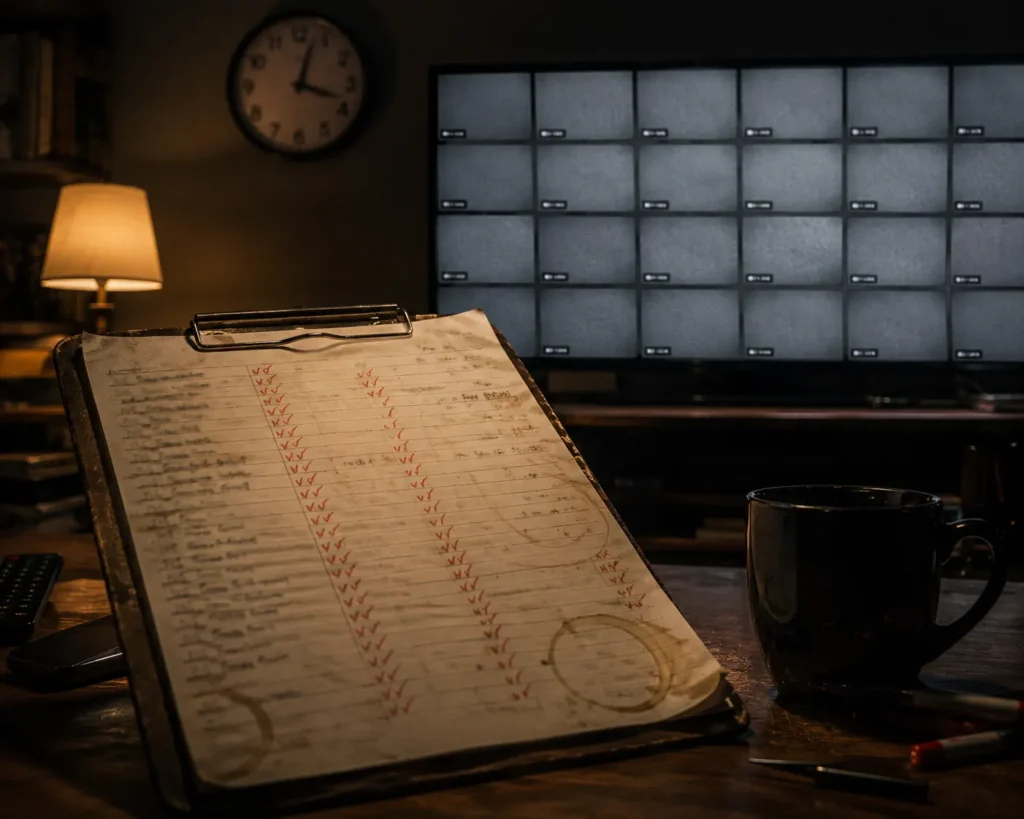
Three candidates entered the test. Candidate A was the household’s existing cable bundle, one hundred and sixty-two channels deep, audited rather than installed. Candidate B was a scraped M3U playlist sourced the way the DIY forums prescribe, pasted into a generic player, and lived with for a full week. Candidate C was the standalone, cloud-based application that connects directly to managed backend servers, deployed on a Firestick 4K and an Android TV panel in the same house.
Four metrics governed the log:
- Buffer events — any visible stall, spinner, or resolution collapse during prime-time viewing.
- Dead channels — tiles that failed to load when selected, counted per evening sweep.
- Maintenance minutes — human labor spent hunting links, re-pasting lists, rebuilding guides, or rebooting hardware.
- True cost — the invoice, plus the value of the evenings the invoice secretly consumed.
Two categories of “free” were refused at the door: card-on-file trials that convert into invoices, and ad-injected players that interrupt sport to sell detergent. Neither is free; both simply bill in a less honest currency.
Phase One Log: Auditing the Cable Bundle (Days 1–7)
The Receipt Archaeology
Day one began in a kitchen drawer, with the statement spread flat and a highlighter doing the auditing. The bundle line: one hundred sixty-two channels priced like a car payment. The box rental: a monthly lease on hardware the provider purchased years ago and intends to replace never. The broadcast fee, the regional sports surcharge, the administrative line that exists because the other lines needed company. Cable, measured calmly with a highlighter, is not a service priced for viewers. It is a toll road priced for captives, with a promotional cliff scheduled for month thirteen like a balloon payment.
What the Money Actually Bought
For seven days, every viewing session in the house was written down. The result was the most depressing number of the entire experiment: eleven. Of one hundred sixty-two channels paid for at premium rates, eleven were actually watched. The remaining one hundred fifty-one were ballast—shopping loops, duplicate feeds, reruns priced like premieres—functioning as structural filler to justify the bundle’s arithmetic. Cost per watched channel, computed at the bottom of the log, came out to a figure the household refused to say out loud at dinner. Candidate A was not eliminated by the test. It eliminated itself.
Phase Two Log: Living Inside an M3U Playlist (Days 8–14)
The Honeymoon Night
Day eight, 21:15. The playlist loaded. The grid populated. For one glowing evening, the DIY method felt like genius—the same channels, the same sport, zero invoice. The log records a single word for that night: honeymoon.
The 24-Hour Decay Curve
Then the physics of scraped infrastructure arrived on schedule.
- Day 9, 20:40 — First buffer storm, mid-match. Fourteen stall events logged in ninety minutes. The final whistle arrived over a frozen frame.
- Day 10 — Evening sweep counted six gray tiles where channels had been. Host servers rotated addresses and tokens overnight; the list was already a photograph of a system that had moved.
- Day 11 — Half the grid dead. Forty minutes spent on forums hunting a replacement link, tested tile by tile like a mechanic scavenging parts for a discontinued car.
- Day 12 — The electronic program guide collapsed into wrong times and blank slots. Nobody maintains a leak. There is nobody to call.
- Day 13 — The replacement playlist, fresh two days earlier, showed the same decay. The 24-to-72-hour death cycle was now a measured curve, not a rumor.
- Day 14 — Weekly tally written in red: 47 buffer events, 31 dead channels, 3 hours 20 minutes of maintenance. Monetary cost: $0. True cost: every one of those minutes, plus the evening the final whistle froze.
The playlist is not free television. It is a subscription paid in weekends, and the price only rises.
Phase Three Log: The Engineered Path (Days 15–30)
Deployment Day
Day fifteen, 19:02. The Firestick received the standalone application through the standard three-move sideload protocol—Downloader utility, quick code, install and purge—timed start to finish at 4 minutes 12 seconds, most of which was the download bar. The Android TV panel followed the same evening. The log notes the absence of a feeling: no link to hunt, no list to paste, no guide to rebuild. The app opened already current, because the maintenance it would have required was happening somewhere else, on servers the household would never see.
Week Three: The Buffer Count Stays at Zero
Prime time is the torture test, because domestic ISPs shape and throttle recognized streaming traffic precisely when everyone watches. Nights nineteen through twenty-one ran the peak window hard—4K sport on one screen, FHD series on the other. The buffer column stayed at zero. The explanation, verified against the platform’s architecture, is layered: streams originate on offshore servers whose signatures domestic throttling systems fail to recognize; a global CDN network hands each device the nearest healthy edge node and switches invisibly when one develops a hiccup; and anti-buffer technology pre-fetches video segments seconds ahead of playback, absorbing network dips in memory before they can reach the glass.
Week Four: The Grid That Heals Itself
Day twenty-one brought the experiment’s quietest revelation. Overnight, three channels the house watched regularly were replaced by healthy equivalents—same content, new infrastructure—without a single human action in the living room. Channel rotation, token refresh, dead-stream surgery: all executed server-side, continuously, invisibly. The VOD wing, audited each morning like a newspaper delivery, added fresh movie and series titles daily, on a maintenance schedule rather than a seasonal promise. Final tally, days fifteen through thirty: zero buffer events, zero dead tiles, zero maintenance minutes, uptime consistent with the platform’s published 99.9%, and a user base of 50,000+ active households sharing the same engineered calm. True cost, written at the bottom of the log in green: $0 monthly fees, no card, no trial, no invoice waiting behind day thirty.
“The field report confirms what the architecture predicts. When rotation, refresh, and failover live on the server side, the household stops being the maintenance department of its own television. The log goes quiet because the work moved to the fleet.” — Senior Network Architect, FREE IPTV CHANNELS
The Instrument Itself: What the Winning App Carries
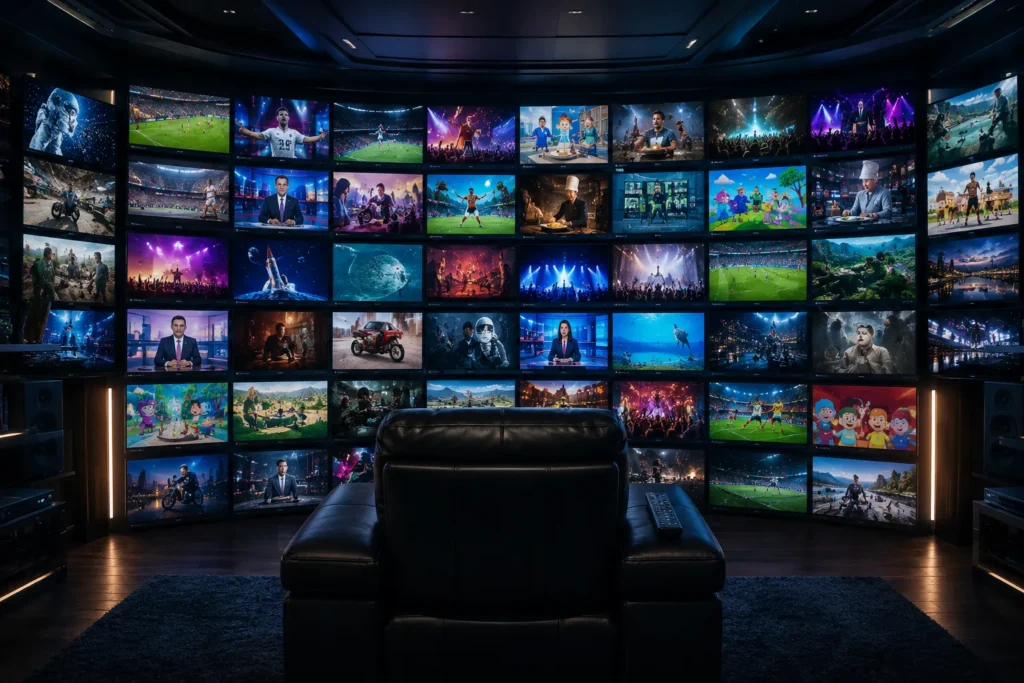
A platform is only as good as its library, and the library is where volume meets craft. The twenty-thousand-channel cloud vault shelves 20,000+ live channels and a daily-refreshed VOD wing into twelve districts a household can actually navigate:
- Live Sports — league nights, combat cards, motorsport weekends, and the overseas feeds domestic packages blackout.
- Latest Movies — theatrical newcomers and catalog classics, added daily, served without pre-roll ads.
- Premium TV Series — complete seasons in order, commercial-free, episodes arriving on schedule.
- Adult Content — strictly PIN-protected and, stronger still, invisible: without your code the shelf appears nowhere in menus, search, or recommendations.
- Live News — domestic and international 24-hour coverage without padded affiliate breaks.
- Documentaries — nature, history, true crime, and science strands for slow evenings.
- International — diaspora broadcasting in dozens of languages, from European public networks to Latin American and Asian staples.
- Kids & Family — a walled, age-safe shelf that never leaks mature tiles into the main grid.
- Music & Arts — concert feeds, video blocks, and gallery programming.
- Gaming & Tech — esports tournaments, hardware channels, and builder culture.
- Lifestyle & Food — cooking, travel, home, and design.
- Drama & Comedy — the syndicated backbone of comfortable background television.
Resolution holds at 4K and FHD across the grid, not as a marketing adjective but as the output of the offshore-CDN-anti-buffer stack described in the week-three log.
Reproducing the Result: The Three-Move Protocol
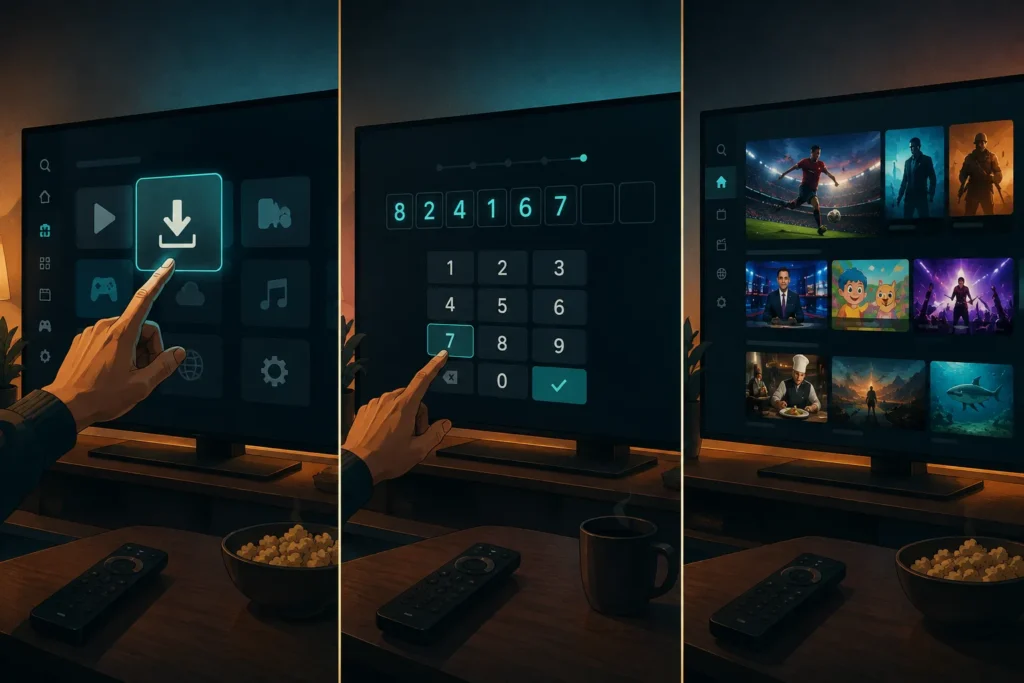
The experiment is reproducible in any household with a Firestick or Android TV device, in under five minutes, using only the stick’s own remote.
Move One — Fetch Downloader and Flip the Manufacturer’s Switch
Install Downloader by AFTVnews from the device store—the community-standard utility for sideloading serious software. Then approve the permission the platform ships with: on Firestick, walk to Settings → My Fire TV → Developer Options and enable Install Unknown Apps (older firmware paints the same door as “Apps from Unknown Sources”); on Android TV, the switch lives under Settings → Security & Restrictions → Unknown Sources. This is not jailbreaking. It is the owner of a computer exercising a permission the manufacturer deliberately left enabled.
Move Two — Enter the Quick Code
Open Downloader and face the URL bar. You will not type an address. The platform publishes a short numeric code—collect the current quick installation code from the homepage or the official guide before you sit down—and the digits resolve straight to the correct build for your hardware. No long strings to mistype, no mirror sites to vet, no guesswork.
Move Three — Install, Open, and Purge the Box
The code triggers the auto-download of the APK. Choose Install, then Open to see the grid light up already current. Finally, return to Downloader’s file list and delete the APK file. The application lives on your device now; the installer is a cardboard box in a studio apartment, and streaming sticks reward owners who keep storage lean. Purge the box. Keep the apartment.
Exit Interview: Questions the Field Report Raises
1. How to get free iptv channels without a credit card or email? Exactly as the phase-three log shows: download the standalone app, install it, open it. There is no payment field, no registration wall, no trial countdown converting into an invoice. $0 is the structure, not the promotion.
2. Will channels rotate out and leave gaps in my lineup? The opposite. Rotation happens server-side to remove failing infrastructure and replace it with healthy equivalents—the day-twenty-one observation. The grid you open is always the grid the servers consider healthy at that moment.
3. My ISP throttles streaming at night. Did the test household suffer it? Peak windows were deliberately stress-tested and the buffer column stayed zero. Offshore origination, CDN edge handoffs, and anti-buffer pre-fetching neutralize the throttling pattern before it reaches your screen.
4. Is the adult district really invisible without the PIN? Measured, not promised. Without the code, the category appears in no menu, no search result, no recommendation rail. Locked is common; invisible is engineered.
5. How much bandwidth does the engineered path need? Roughly 10–15 Mbps steady for FHD and about 25 Mbps for comfortable 4K, ideally over 5 GHz Wi-Fi or ethernet. The pre-fetch reserve forgives brief dips that freeze generic players.
6. Does the same protocol work on Android TV? Yes—the permission switch sits in a different menu, but Downloader, the quick code, and the purge step behave identically across the Android streaming family, as the second panel in the test house proved.
7. What is the catch—ads injected into the streams? The log would have recorded them; it did not. No mid-match detergent breaks, no pre-roll before movies. The streams arrive as produced.
8. Can every TV in the house run this without extra fees? Every Firestick and Android TV you own. No hardware binding, no per-device surcharge. The fee remains $0 each time, which is the only behavior a genuinely free platform can show.
The Verdict Line
Thirty days, three economies, one surviving log column in green. Cable charged the household for one hundred fifty-one channels it never watched and a box it never owned. The playlist charged in weekends—3 hours 20 minutes of maintenance, 47 buffer events, a frozen final whistle. The engineered path charged nothing at all: 20,000+ live channels, a daily-refreshed VOD wing, 4K and FHD held steady through peak throttling, 99.9% uptime, 50,000+ households sharing the calm, and zero minutes of human labor after the 4-minute-12-second deployment. How to get free iptv channels, answered by measurement rather than belief: stop renting leaks, stop subsidizing toll roads, and put a self-healing grid behind the glass.
The coffee-table log is closed. Yours can open tonight—claim the zero-dollar channel grid, run the three-move protocol, and let the next promotional cliff land on somebody else’s kitchen counter.