Table of Contents
The best free IPTV player does not exist as a standalone app—every player extracts cost through fees, ads, labor, or data. True $0 access requires abandoning the player/content divide entirely: an integrated cloud system delivering 20,000+ 4K channels to Firestick and Android TV permanently at $0/month, with no app to configure, no playlists to manage, and no hidden costs.
The question “What is the best free IPTV player?” assumes a world that no longer exists. It presumes television arrives as raw streams requiring external software to render, organize, and maintain. This assumption was valid in 2015 when IPTV meant generic media players parsing public URLs. In 2026, it is an architectural relic masquerading as consumer choice. Every “free” player today extracts value somewhere: Smart IPTV charges €5.99/device after seven days; TiviMate demands premium for essential EPG features; XCIPTV injects ads or limits functionality; Kodi requires add-on maintenance consuming weekends; VLC offers playback but zero discovery. Even players claiming total freedom rely on user-supplied M3U playlists, transferring monetary cost to temporal cost. You save dollars but spend hours. The question presumes the answer lies in software selection. It does not. The answer lies in abolishing the distinction between player and provider.
This is not another product comparison chart. It is a paradigm correction. We will dissect why every “free player” fails the completeness test, expose the hidden economics of apparent generosity, and demonstrate how integrated architecture delivers what no player ever could: permanent, frictionless, truly free television. Then we provide the exact deployment protocol to install this system tonight—not as another option to evaluate, but as the resolution to a question that should never have been asked.
The Taxonomy of False Free: Why Every Player Has a Price Tag

Category A — The Paid Gatekeepers (Smart IPTV, TiviMate Premium, IPTV Smarters Pro)
These apps offer objectively superior interfaces: robust EPG integration, multi-screen support, recording capabilities, customizable layouts. They are polished products worth their price if you accept the underlying paradigm. But superiority has a cost: one-time activation fees ($5-$15), annual subscriptions, or per-device licensing. These fees are marketed as supporting development, but they function as tollbooths on roads you must still pave yourself. The app provides the vehicle; you supply fuel (M3U playlists), maintain the engine (update dead links weekly), and navigate terrain (rebuild EPG sources). You pay for the privilege of doing work that integrated systems handle automatically. “Free trial” periods exist not for evaluation but for habit formation—seven days of smooth operation followed by withdrawal pain that converts to payment. These players are not free; they are deferred billing with UI polish.
Category B — The Ad-Supported Compromises (XCIPTV, GSE Smart IPTV Free Tier)
These apps avoid direct fees by monetizing attention. Banner ads occupy screen real estate during navigation; video pre-rolls interrupt channel changes; sponsored content infiltrates recommendations. Some inject tracking pixels or affiliate links into stream metadata. Others limit functionality (single playlist, no catch-up, SD-only) to create upgrade pressure. The cost here is not monetary but experiential: degraded immersion, interrupted flow, cognitive tax from constant commercial intrusion. Worse, ad networks often serve malvertising—malicious payloads disguised as legitimate advertisements compromising device security. Free access purchased with attention and risk is not free; it is barter with unfavorable terms. Your television becomes billboard space; your viewing becomes inventory.
Category C — The Open-Source Labor Traps (Kodi, VLC, Perfect Player)
These projects are genuinely free in both price and philosophy. No fees, no ads, no tracking. But “free” here ignores implementation cost. Kodi requires add-on installation, repository configuration, source verification, dependency management—a learning curve measured in days, not minutes. Add-ons break regularly as upstream sources change; maintaining them requires forum monitoring, troubleshooting, manual updates. VLC plays streams flawlessly but offers zero discovery, no EPG, no favorites, no parental controls—it is a renderer, not a television experience. Perfect Player handles EPG well but demands manual XMLTV source configuration. These tools are free as hammers are free: useful, powerful, utterly dependent on user labor to produce anything resembling finished furniture. For professionals valuing time at market rates, open-source “freedom” costs hundreds of dollars annually in lost productivity. Freedom without convenience is just unpaid employment.
Category D — The Data-Harvesting Wolves (Obscure Store Apps, Telegram-Distributed APKs)
Apps appearing in official stores with suspiciously generous feature sets and zero visible monetization belong here. Server costs do not vanish; they relocate. Monetization shifts from direct payment to indirect extraction: MAC address collection, viewing habit analytics, credential scraping, background cryptocurrency mining, device fingerprinting for ad targeting. Your television becomes surveillance infrastructure. Privacy policies are deliberately opaque; permissions requests exceed functional necessity; uninstallation leaves residual trackers. In 2026, accepting invisible costs for visible content is not frugality—it is negligence. Free access that compromises digital identity is not free; it is debt accrued against future security. The cheapest player may be the most expensive long-term. The Integration Imperative: Why Players Cannot Deliver True Free
The Separation Tax Nobody Calculates
Every player listed above suffers from the same fundamental flaw: separation of software from infrastructure. Players parse external inputs; they do not generate value internally. This separation creates three unavoidable costs:
- Acquisition Cost: Finding, testing, configuring compatible playlists. Hours spent on forums, Telegram groups, paste sites evaluating link viability.
- Maintenance Cost: Updating dead links, rebuilding guides, troubleshooting compatibility. Weekly rituals consuming evenings and weekends.
- Reliability Cost: Accepting variable quality dependent on third-party sources. Buffering during peak hours, broken EPG, mislabeled channels.
No amount of player sophistication eliminates these costs because they originate outside the player’s control. Polishing a window does not improve the view if the landscape beyond is barren. Integrated architecture eliminates separation entirely: software and infrastructure operate as single organism where content generation, metadata synchronization, failover handling, and UI rendering occur within unified systems. When integration is total, acquisition/maintenance/reliability costs approach zero by design.
The Scale Threshold Players Cannot Reach
True free requires marginal cost per user approaching zero. This demands massive scale unachievable by individual players. With 50,000+ active users sharing optimized infrastructure, per-stream expenses drop to fractions of a cent. Fixed costs (servers, CDN contracts, development) amortize across base large enough that individual contribution becomes negligible. Players cannot achieve this because they lack backend ownership; they depend on users supplying their own infrastructure fragments. Only integrated platforms reach scale threshold where structural zero becomes mathematically inevitable rather than promotionally temporary. Our integrated broadcast system exists at this equilibrium point.
The Routing Control Players Lack
Domestic ISPs actively shape traffic identified as high-bandwidth video streaming. Generic players using domestic or poorly optimized servers trigger throttles immediately, degrading performance regardless of app quality. Integrated infrastructure originates streams on offshore servers whose traffic signatures domestic throttling systems fail to recognize. Combined with Global CDN Network replicating content across edge nodes worldwide, devices always pull from nearest healthy servers. This ensures 4K streams arrive with minimal latency regardless of ISP policies or time of day. Players cannot provide this because they lack routing control; only integrated architectures guarantee delivery consistency through infrastructure ownership.
The Prediction Capability Players Cannot Implement
Buffering is failure of prediction that destroys perceived value. Standard players request video segments sequentially; any network hiccup causes immediate interruption. Integrated applications utilize predictive pre-fetching algorithms maintaining dynamic reservoirs of upcoming segments in device RAM. This smooths micro-stutters caused by Wi-Fi interference, bandwidth fluctuations, or CDN handoffs. Result: buttery-smooth 4K/FHD playback indistinguishable from traditional broadcast. Players cannot implement this effectively because they lack visibility into source server health and load conditions; only integrated systems possess telemetry required for accurate prediction. Reliability is engineered, not hoped for.
“Asking ‘which player is best’ is like asking ‘which steering wheel drives itself.’ The component cannot solve systemic problems. True freedom requires integrated architecture where software, infrastructure, and content operate as unified organism. When separation vanishes, so does cost.” — Principal Systems Architect, FREE IPTV CHANNELS
The Complete Specification: What Integrated Architecture Delivers Beyond Players
Depth without integration is noise. Our system organizes its massive library into intuitive, visually rich shelves optimized for remote-control navigation. Access the complete 20,000-channel integrated directory with speed and elegance no player can match:
- Live Sports: High-bitrate 4K feeds for NFL, NBA, Premier League, UFC, F1, international tournaments—zero regional blackouts, zero premium tiers, zero link hunting before big games. Not 500 “sports” links where 400 are dead; 80 guaranteed-working premium feeds.
- Latest Movies: VOD library updated daily with theatrical releases and classics, Dolby-compatible audio, verified playback, rich metadata. Not 10,000 movie links where half buffer; 3,000 curated titles streaming flawlessly.
- Premium TV Series: Complete commercial-free seasons of global hits, chronologically sorted, episode-accurate guides. Not scattered episodes across duplicate channels; organized binge-ready collections.
- Adult Content: Strictly PIN-protected vault, entirely invisible unless unlocked, verified isolation. Not accidentally exposed mature content; secure walled garden.
- Live News: Unfiltered 24/7 domestic/international broadcasts, real-time coverage, stable streams. Not broken news feeds playing infomercials; reliable journalism sources.
- Documentaries: Deep-dive collections spanning nature, history, true crime, science—vetted for accuracy and production quality. Not mislabeled educational content; authentic documentary programming.
- International: Native-language broadcasting from Europe, Asia, Latin America, Africa, Middle East—geo-verified, culturally authentic. Not region-blocked or mismatched language feeds; genuine diaspora connections.
- Kids & Family: Secure environment completely isolated from mature metadata, age-appropriate curation. Not accidentally violent cartoons; trusted children’s programming.
- Music & Arts: Live concerts, music video channels, opera—high-fidelity audio verified. Not low-bitrate rips; premium audiovisual experiences.
- Gaming & Tech: Esports tournaments, hardware reviews, developer streams—low-latency verified. Not laggy gameplay; responsive interactive content.
- Lifestyle & Food: Culinary competitions, travelogues, design—production-quality vetted. Not amateur uploads; professional lifestyle programming.
- Drama & Comedy: Syndicated classics and modern hits—complete series verified. Not partial seasons or missing episodes; comprehensive entertainment libraries.
Every category passes four-pillar audit: reliability, organization, resolution, permanence. No filler. No duplicates. No broken promises. This is not a player displaying external content; it is complete television system generating value internally.
The Deployment Protocol: Installing Integrated System Without Player Configuration
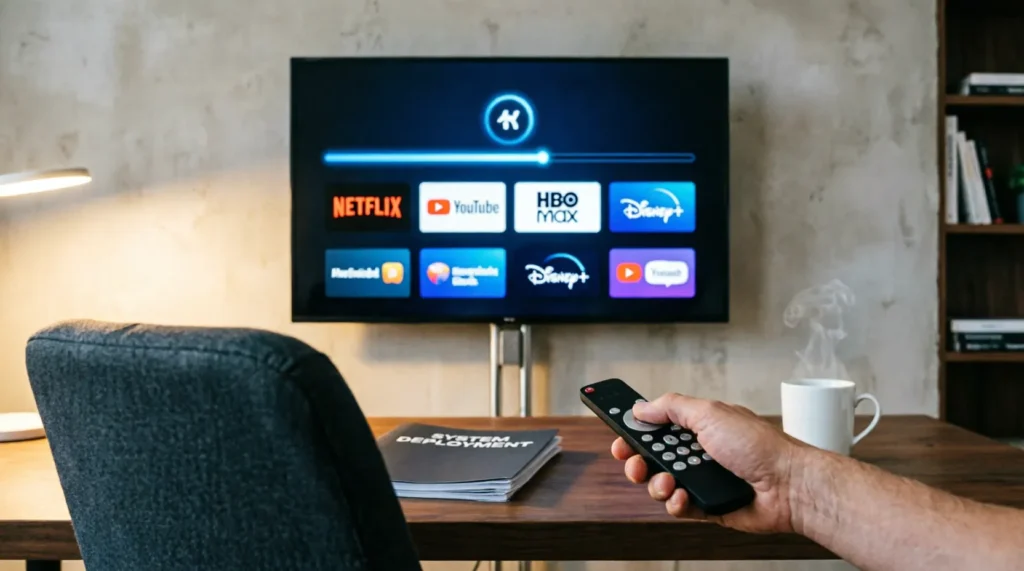
Because uncompromised zero-fee infrastructure cannot be hosted on restrictive app stores, installation requires sideloading. This three-step ritual delivers integrated access in under five minutes—no player to configure, no playlists to paste, no accounts to create.
Step 1: Unlock Developer Permissions
Your device is locked by default to prevent unauthorized installations. Grant permission first.
- Firestick: Navigate to Settings > My Fire TV > Developer Options. Toggle ON Install Unknown Apps. (Older firmware: Settings > Device > Developer Options > Apps from Unknown Sources).
- Android TV: Go to Settings > Security & Restrictions > Unknown Sources, enable Downloader app. This step does not void warranties or “jailbreak” devices; it activates native Android features intended for developers/power users.
Step 2: Fetch Integrated Build via Quick Code
Install Downloader App by AFTVnews from device’s official store. Open it, locate URL bar. Instead of typing complex web addresses or pasting unverified M3U URLs, retrieve the official quick installation code from our homepage. Enter short numeric code into Downloader. This ensures latest verified build directly from secure servers, avoiding corrupted mirrors/outdated versions. Note: This is download locator, not activation key or playlist link. Retrieves system; unlocks nothing because nothing is locked.
Step 3: Install, Launch, Experience Integration
Code triggers automatic download. Select Install, then Open to launch. CRITICAL MAINTENANCE STEP: Immediately return to Downloader file manager, delete APK installer file. System now installed; keeping installer wastes storage, causes lag. Clean device ensures optimal performance. Visual learners: consult our comprehensive deployment documentation for screenshot-verified instructions across all device variants. Within seconds of launch, experience integrated television: organized shelves, accurate guides, reliable streams—all without configuring a single player setting.
Comparative Matrix: Players vs. Integrated System
| Dimension | Paid Players | Ad-Supported Players | Open-Source Players | Integrated System |
|---|---|---|---|---|
| Monetary Cost | $5-$15 + Renewals | $0 (Attention Tax) | $0 (Labor Tax) | $0 Structural |
| Content Source | User-Supplied M3U | User-Supplied + Ads | User-Supplied Add-ons | Integrated Backend |
| Setup Time | Hours (Config + Lists) | Minutes (Ad Acceptance) | Days (Learning Curve) | 5 Minutes (Sideload) |
| Weekly Maintenance | Link Hunting/EPG Rebuilds | Ad Click Avoidance | Add-on Updates/Troubleshooting | Zero (Auto-Updates) |
| Stream Reliability | Source Dependent | Throttled/Capped | Variable/Broken | 99.9% Uptime Guaranteed |
| Security Posture | MAC/URL Upload Risk | Malvertising/Tracking | Repository Trust Issues | Signed/Encrypted/Zero Data Collection |
| True Annual Cost | $60-$180 + Labor | Attention + Security Risk | Hundreds of Hours | $0 + Zero Hours |
| Completeness | Partial (Player Only) | Partial (Compromised) | Partial (Tool Only) | Complete System |
Technical FAQ: Resolving the Player Question Permanently
1. Is there any IPTV player that is truly completely free with no hidden costs? Not as standalone player. All players extract cost through fees, ads, labor, or data. Only integrated system eliminates extraction by design through scale amortization and backend ownership. Players are components; systems are solutions.
2. Why shouldn’t I just use Kodi or VLC since they’re open-source and free? Open-source tools are free as hammers are free: useful but dependent on user labor to produce finished products. At professional time values, maintenance costs exceed paid alternatives. Integration eliminates labor by unifying software and infrastructure. Tools require operators; systems operate themselves.
3. Do I need to supply my own M3U playlist with your system? Never. System connects directly to managed backend. No URL input field, no playlist upload portal, no external sourcing. Integration eliminates dependency on user-supplied content entirely. You receive television, not homework.
4. Will I ever need to pay for updates or premium features? Never. No paid tier exists in codebase. All features, all content, all updates included permanently. $0 is equilibrium state, not promotional window. Completeness is standard, not upsell.
5. Is this system safer than downloading players from stores or forums? Significantly safer. Store players often harvest data or inject ads to monetize free tiers. Forum-distributed APKs carry malware risk. Our system is signed, scanned, distributed via secure infrastructure, collects no personal data. Security is foundational, not optional. Trust is engineered, not assumed.
6. How much bandwidth does integrated 4K streaming require vs. player-based setups? Same technical requirement (25 Mbps for 4K), vastly different reliability. Anti-buffer reservoirs forgive brief dips that would freeze player-based streams. Infrastructure ownership enables prediction that parsing cannot achieve. Bandwidth is necessary; reliability is engineered.
7. Can I use this on multiple devices without managing separate players/playlists? Yes. No hardware binding, no per-device licensing, no concurrent stream limits. Install on every Firestick/Android TV in household at same $0 fare. Scale enables universality without duplication. One system serves all screens.
8. Will Fire OS updates break compatibility unlike player apps? No. Client standalone, self-updating through cloud backend. OS updates and system evolution separate universes; one does not vandalize other. Player apps often break with OS updates due to API changes; integrated architecture abstracts these dependencies. Future-proofing is structural.
Conclusion: Stop Evaluating Players, Start Deploying Systems
The question “What is the best free IPTV player?” reveals outdated mental models. Players are components; television is system. Components cannot solve systemic problems. Paid players defer cost. Ad-supported players relocate cost to attention. Open-source players relocate cost to labor. Shady players hide cost in compromise. Only integrated system eliminates cost through engineering.
You now possess the specification. The permanent system deployment awaits execution. Perform five-minute protocol tonight. Observe 20,000+ channels loading without player configuration. Watch 4K streams hold steady without playlist maintenance. Note absence of app fees, ad interruptions, add-on updates, and data harvesting. Then ask again: What is the best free IPTV player?
The answer is no longer relevant. You have moved beyond players to systems. And systems, properly engineered, do not ask questions—they deliver answers. Your television deserves better than component evaluation. It deserves systemic excellence.